The Global Faculty Market, 2026
Where research-active faculty move between five regions, the corridors that carry them, and an opening for universities hiring in each.
Five regions · 8,762,862 researchers · moves detected 2021 to 2026
The eastward turn: who is arriving at Gulf universities, from where, in which fields, and where the openings are.
Six Gulf states · 215 institutions · moves detected 2021 to 2026
Key figures
Source: ATLAS movement registry, read 18 October 2026, built from OpenAlex author and work records. Complete moves, 2021 to 2024; counts are a floor.
Findings
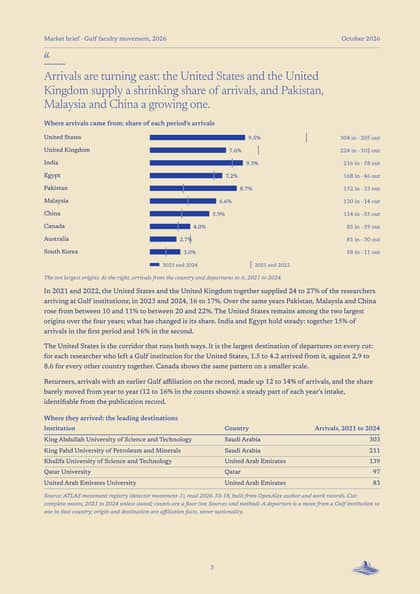
Arrivals are turning east: the United States and the United Kingdom went from between 24 and 27% of arrivals to between 16 and 17%.
The United States is the corridor that runs both ways, and the largest destination of departures.
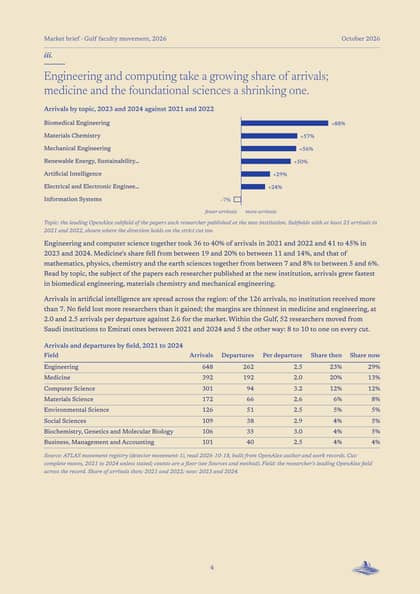
Engineering and computing take a growing share of arrivals; medicine and the foundational sciences a shrinking one.
Within the Gulf, moves run towards the United Arab Emirates, 8 to 10 to one.
Inside the brief
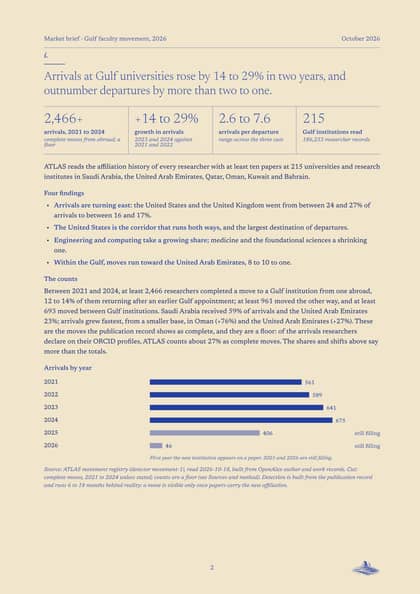
Arrivals at Gulf universities rose by 14 to 29% in two years, and outnumber departures by more than two to one.
Arrivals are turning east: the United States and the United Kingdom supply a shrinking share, and Pakistan, Malaysia and China a growing one.
Engineering and computing take a growing share of arrivals; medicine and the foundational sciences a shrinking one.
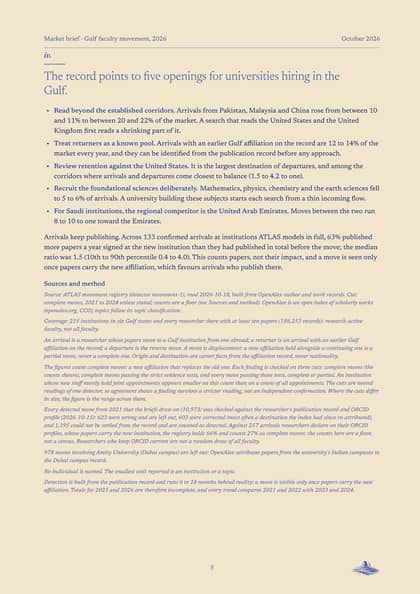
The record points to five openings for universities hiring in the Gulf.
Read the full brief, with every chart, table, source, and method note.
Where research-active faculty move between five regions, the corridors that carry them, and an opening for universities hiring in each.
Five regions · 8,762,862 researchers · moves detected 2021 to 2026
About half of arrivals raise their institution's research average. Their record before the move shows which half.
Confirmed arrivals at Gulf institutions · moves complete by 2023 · outcomes through 2025